Free Shipping over $40

blog

Seek the Sunshine @ Taos + Santa Fe, New Mexico

Remote, Rugged, & Ripe for Exploration

By Ashley Peterson

Being south in latitude and with nearly 300 sunny days a year, there’s a good chance you’ll be skiing in the sunshine in New Mexico. The snow here is unique because it is often dry, cold, and powdery in the winter, lasting for days in the higher elevation trees. The warmth and sunshine also produce great corn skiing in the spring. The snowpack tends to be more consistent due to more minor temperature fluctuations than you are likely to see further north. Best of all, in New Mexico you can still find unparalleled solitude and adventure.

The skiing history in New Mexico is rich and dates back to the late 1800s and early 1900s with prospectors trying out their skis for both practical uses and for casual fun. New Mexico is also home to what is likely the oldest-known photo of a Native American on skis. The image from around 1900, shows a man from Taos Pueblo, thought to be a mail carrier, on skis in Hondo Valley (just a few miles from Taos Ski Valley).

Credit for the development of skiing in New Mexico must also include mention of the courageous and inventive New Mexicans who were motivated by their passion for the mountains and snow and helped build the fiercely independent ski culture that lives on today.

Backcountry skiing in the Taos and Santa Fe area can be divided into three geographical sub-regions. The first is around the Taos Mountains and includes Wheeler Peak and the backcountry touring adjacent to Taos Ski Valley. The second sub-region is the area around the Truchas Mountains, a lesser-explored range between Taos and Santa Fe. The third sub-region is west of Santa Fe, including the mountains from Tesuque Peak north to Santa Fe Baldy as well as the Ski Santa Fe sidecountry. Read on to find out more about each of these sub-regions.

New Mexico's Desert to Summit Views
Taos Ski Valley and Wheeler Peak Wilderness

The valleys around Wheeler Peak and Taos Ski Valley have drawn explorers for centuries. Wheeler Peak (13,167’) is the highest peak in the state of New Mexico. In the 1870s,  U.S. Army Major George Montague Wheeler began to make a topographic map of the southwestern United States, including New Mexico. After climbing the peak, he named it after himself. In fact, at least six mountains in the southwestern US are named after him. However, he was likely not the first to summit Wheeler Peak, and it is believed that the people of the Taos Pueblo had likely climbed it for many years before a white man came to stand on top. Early Taos ski pioneers also include Ernie and Rhonda Blake, among others, who are largely credited for having the grit and vision to develop world-class skiing in the area in the 1950s.

With the evolution of backcountry skiing technology, access to this valley has improved and the area offers vast opportunities for the enthusiastic adventurer. Many of the most popular tours in this area can be found in the Lake Fork Drainage around Williams Lake and Wheeler Peak, but there are also plenty of exploratory options north towards Gold Hill. The expansive Lake Fork Drainage is marked by the Taos Ski Valley Resort situated on the north-facing flanks of Kachina Peak in the northwest and wrapping south towards Lake Fork Peak, then southeast and east towards Simpson Peak, then north to Wheeler Peak, Mount Walter, and the La Cal Basin. One trailhead will gain you access to ten distinct zones with over 70 possible descents, but do not expect to be the only ones out there on a weekend with good snow.

From the Wheeler Peak East Fork Bowl, to the southeast of Simpson Peak, you can see a brilliant turquoise body of water known as Blue Lake, or Ba Whyea, which is a sacred land to the native Taos Pueblo. Admire it from afar but don’t ski off the south side of Simpson into this basin. The Taos Pueblo was settled from 1200-1250 A.D. and Blue Lake has been a place of worship and spiritual significance since that time. In 1906, the US Congress grabbed this land from the native peoples and made it part of the national forest. For 64 years, protesting ensued and finally, in 1970, around 48,000 acres of land, including Blue Lake, was returned to the Taos Pueblo.

Backcountry access in the Taos area is generally reliable from the key trailheads (Wheeler Peak, Long Canyon, and Gavilan Trailheads). Sidecountry access (skiing out of bounds) from Taos Ski Valley Resort is not allowed during the ski season, but uphill access is permitted after the resort closes each year in April. Always check resort policies before heading out.
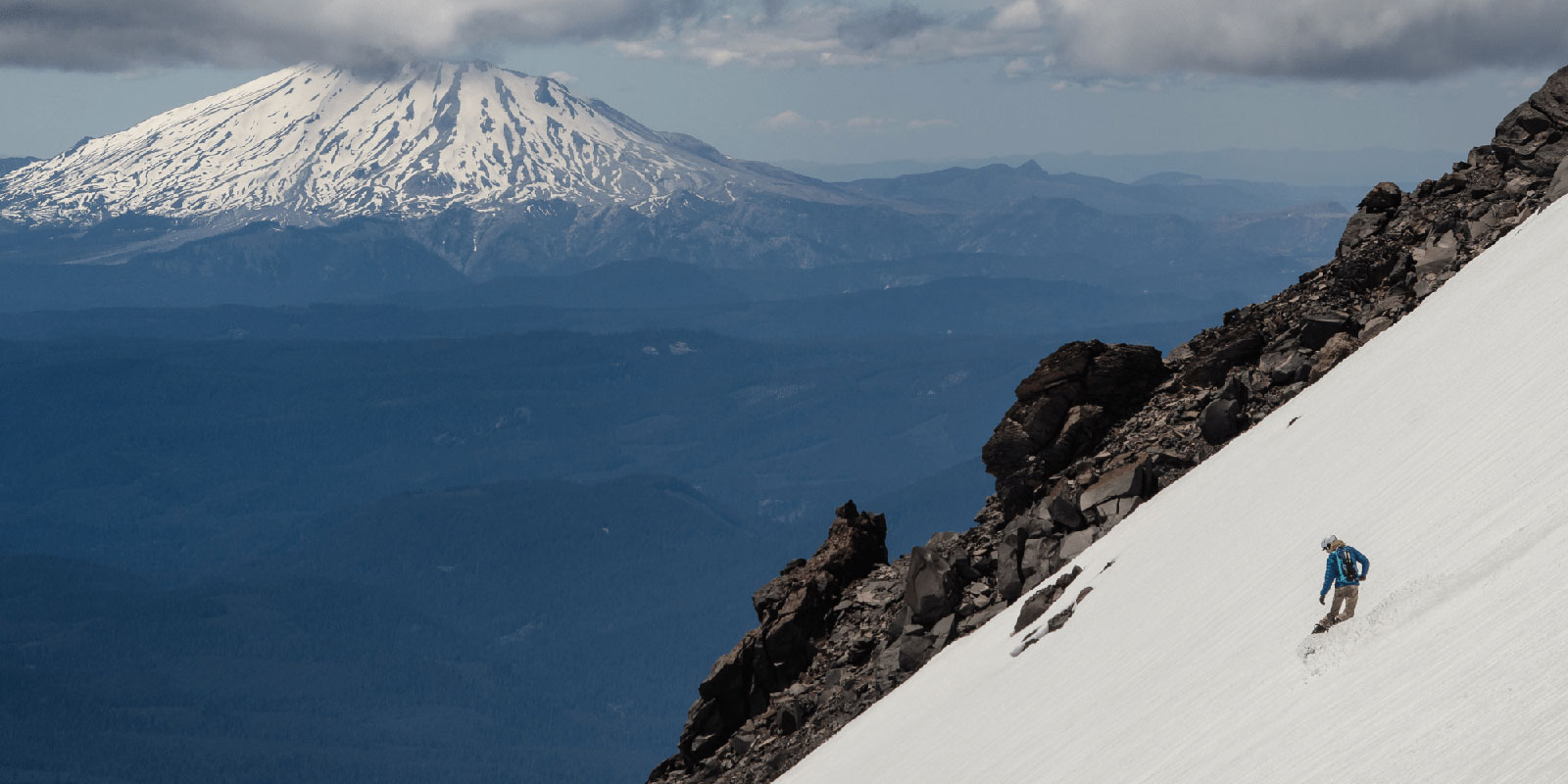
Lake Fork Peak from Kachina Peak
Fresh Pow off Lake Fork Peak
Gettin' After the Sunny Ridge Lines
The Truchas Range

The Truchas Range (Spanish for ‘trout’), to the south of Taos along the Sangre de Cristo Mountains is a north-south running massif with four discernible summits: North Truchas Peak, Middle Truchas Peak, Medio Truchas Peak, and South Truchas Peak. South Truchas is the highest of the four and is the second highest peak in the state at 13,108’. It is also the most southerly peak in the continental United States to rise higher than 13,000’. 

The Truchas Range offers robust and rugged backcountry ski endeavors marked by unpredictability and remoteness in every direction. Skiing in this zone should not be underestimated. It is a high commitment zone that takes serious planning and preparation. Search and Rescue is far away and there are limited services; no avalanche forecast, no ski patrol, no cell phone coverage, no paved roads, and no huts. You’re out there! Be prepared to experience a very real sense of wilderness. 

Although seldom traveled, the ski mountaineering objectives in the Truchas Range come with rewarding payoff. Once-in-a-lifetime lines, solitude, and bucket-list expeditions define this winter landscape.

The Truchas Range From the High Road to Taos
The Santa Fe Mountains and Sidecountry

One of the first developed ski areas in NM came in the 1930s at Hyde Park near Santa Fe. In 1949, the Sierras de Santa Fe group founded the Santa Fe Ski Basin and raised funds to build its first chairlift. The 50s and 60s saw huge changes and major developments for resort skiing in the region and it has only continued to grow in popularity since.

Located in a beautiful alpine forest between 10,350’ (base) and 12,075’ (summit), Ski Santa Fe is one of the highest, and furthest south, ski resorts in the US.

Access to backcountry skiing is excellent in this region in part because Ski Santa Fe Resort currently allows for gated access to the sidecountry terrain. Always check the Ski Santa Fe website for any updated rules and policies before heading out.

Several longer tours as well as some of the longest descent lines in the area can be found to the north towards Santa Fe Baldy (12,261′), the highest peak in this sub-region.

Whether you’re looking for an entirely remote objective in the Truchas Range, the popular and well-known lines near Taos, or something in between near Santa Fe, there’s a beautiful sunny tour waiting for you in New Mexico.

Morning Approach in Santa Fe NF
Final Boot up the Couloir
Here Comes The Sun
Get the Forecast, Get the Gear, Get a Guide!

WORKS CITED

Blackwood, Daniel Gibson and Jay, et al. “More than a Century of Skiing in New Mexico.” Santa Fe New Mexican, 22 Nov. 2022, www.santafenewmexican.com/news/adventure/more-than-a-century-of-skiing-in-new-mexico/article_168f55ca-0c18-11ec-bf7d-07959215bc67.html#:~:text=The%20first%20developed%20ski%20areas,State%20Park)%20above%20Santa%20Fe.

Pacheco, Ana. “Taos Pueblo’s Sacred Blue Lake.” History in Santa Fe, 30 Aug. 2022, historyinsantafe.com/taos-pueblo-blue-lake/.

“Ski Santa Fe.” Wikipedia, Wikimedia Foundation, 20 Dec. 2022, en.wikipedia.org/wiki/Ski_Santa_Fe.

“Truchas Peak.” Wikipedia, Wikimedia Foundation, 1 Oct. 2023, en.wikipedia.org/wiki/Truchas_Peak.

“Why Wheeler Peak?” National Parks Service, U.S. Department of the Interior, www.nps.gov/grba/learn/historyculture/why-wheeler.htm. Accessed 25 Oct. 2023. 

Share :
Share with our community

Comments